
Why Made-to-Order Is the Sustainable Answer to Fashion's Overproduction Problem
Fashion has a problem it doesn't like to talk about. It's not fabric choice, and it's not shipping emissions – it's the enormous volume of clothing and footwear produced that nobody ever buys.
Estimates across the industry suggest that up to 30-40% of garments produced each season never sell at full price. Some are discounted into oblivion. Some are shipped to landfill markets abroad. Some – in the most infamous cases – are burned or shredded by the very brands that made them, to protect price positioning. All of it represents materials, labor, water, and energy spent on products that served no one.
The industry's response has mostly focused on inputs: better fabrics, recycled materials, lower-impact dyes. These matter. But they treat the symptoms of a deeper structural issue – the production model itself. As long as brands manufacture in bulk based on demand forecasts, overproduction is not a possibility. It's a certainty. Forecasts are always wrong; the only question is by how much.
The forecast trap
Traditional fashion production works on speculation. A brand estimates how many units of each style, color, and size will sell next season, places factory orders months in advance, and hopes the market agrees. When it doesn't – and it never fully does – the surplus becomes someone's problem: the discount rack, the outlet store, the incinerator. The perverse part is that overproduction is often the rational choice under this model. Running out of stock means lost sales, so brands deliberately over-order. The cost of excess inventory is built into the price of everything, paid for by the customers who do buy – and by the environment, which absorbs the waste. Faster production cycles have made this worse, not better. When new styles drop weekly, forecasting accuracy collapses further, margins for error grow, and the volume of unsold product scales accordingly.
Made-to-order: production without speculation
There is a production model, though, in which overproduction is structurally impossible: made-to-order. Nothing is manufactured until a specific customer has ordered it. No forecasts, no bulk runs, no warehouse of inventory waiting to be sold – or not sold. The logic is almost embarrassingly simple. Every product made has a buyer before it exists. Material is cut only for confirmed orders. Labor is spent only on items that will actually be worn. The clearance rack, the seasonal dump, the destruction of unsold goods – the entire downstream waste chain disappears, because the surplus that feeds it is never created.
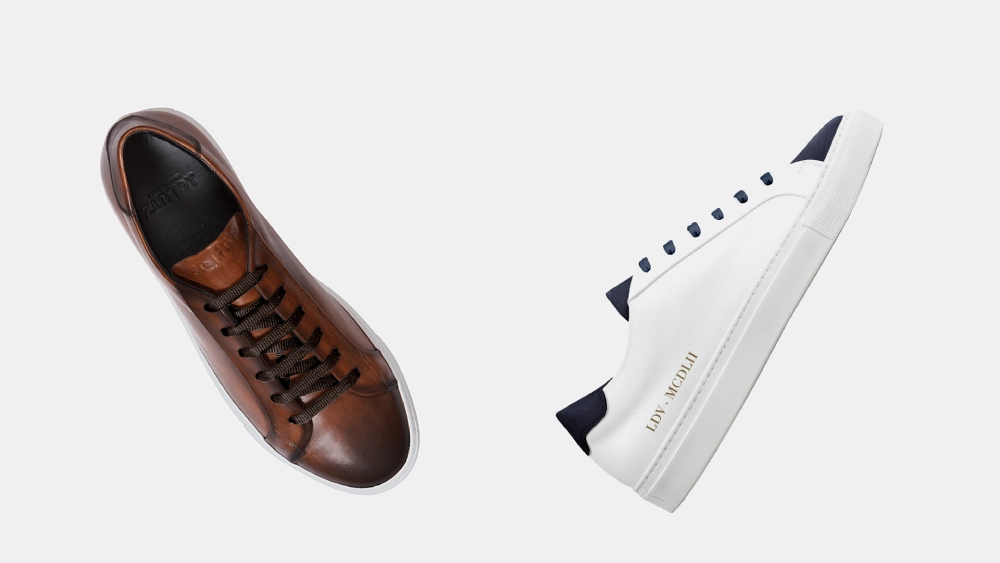
Made-to-order has long existed at the edges of fashion – in bespoke tailoring, in bridal, in certain corners of luxury. What's changed is that it's now viable in categories where it was once considered impractical. Footwear is one of the clearest examples. A brand like J.C.LUTZ, which produces handcrafted leather sneakers in Italy exclusively on a made-to-order basis, illustrates how the model works in practice. Each pair is produced at the atelier only after the customer places their order, which they design themselves (they have a custom tool for designing your own pair of sneakers as you like). There is no inventory to overproduce, no stock to liquidate at season's end, and no pile of unsold pairs quietly written off. Production and demand are matched one-to-one, by design.
The material layer
The sustainability case for made-to-order doesn't stop at volume. It extends to what the products are made from, and how long they last. Made-to-order economics favor durable materials. When a brand isn't racing to hit a seasonal price point across thousands of speculative units, it can invest in inputs that cost more but perform longer. In leather goods, that often means vegetable tanning – the slow, centuries-old method that uses plant-based tannins instead of the chromium salts that dominate mass leather production. Vegetable-tanned leather takes weeks to produce rather than days, but it rewards the patience: it ages and develops character over years of wear instead of degrading. That longevity is itself a sustainability argument, and arguably the most underrated one. The most effective way to reduce fashion's footprint is not to recycle more – it's to buy less, by buying things that last. A pair of shoes worn for six or eight years displaces every cheaper pair that would have been bought and discarded in the same period. Durability is waste prevention, spread over time.
The honest trade-off
Made-to-order asks something of the customer: patience. Production takes time – typically a few weeks rather than two-day shipping. In a market trained on instant availability, that's a real behavioral shift. But the wait is not a flaw in the model. It's the visible cost of a system that doesn't gamble on demand. The alternative – instant availability – is only possible because someone, somewhere, produced far more than they knew they could sell. Every "in stock, ships today" label sits on top of a mountain of speculative production. There's also a quieter benefit to the waiting: intentionality. A purchase that takes weeks to arrive tends to be a considered one. Made-to-order naturally filters out the impulse buying that fuels fashion's churn – the purchases that are worn twice and forgotten.
A model, not a niche
Made-to-order won't replace all of fashion production, and it doesn't need to in order to matter. Its significance is as proof of concept: it demonstrates that the industry's waste is not inevitable, but a consequence of choices – and that a different choice exists. For consumers, the takeaway is practical. The most meaningful sustainability signal isn't a certification badge or a recycled-content percentage. It's a simpler question: did this product exist before I asked for it? When the answer is no, overproduction – fashion's largest and least discussed waste stream – has been designed out entirely. It's a correction, not a trend. And it's long overdue.
Hits: 2779 | Leave a comment
About the Author

Silvia Kabaivanova
As the founder of Be Global Fashion Network and several other fashion websites, Silvia has been working for more than 20 years covering fashion industry trends and news. With a passion for the fashion business, she focuses on sustainable fashion and innovations, custom fashion and print on demand services. Silvia is a Chairman of Bulgarian Fashion Association. You can reach her at silvia@bgfashion.net