
The Meaning Behind Meteorite Rings and Their Celestial Design Appeal
Meteorite rings arrive with a built-in narrative that no marketing department can manufacture. The raw ingredient is older than any human craft tradition, formed in the same early violence that shaped planets and left debris to wander. When a fragment lands on Earth and is later cut, forged, and finished, the object becomes a small treaty between deep time and daily life. That unusual provenance changes how people talk about the ring itself. It is not merely a band; it is a relic of cosmic travel made wearable.
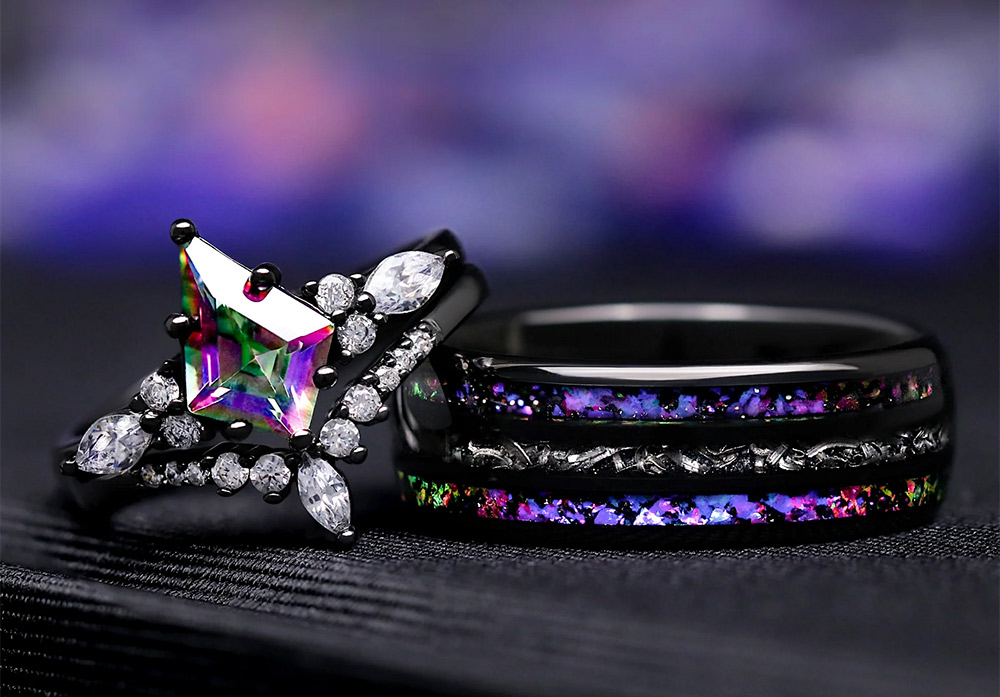
The meaning begins with scale, the kind that makes ordinary milestones feel sharper and more deliberate. A wedding date, an anniversary, or a personal turning point can seem fleeting until it is paired with a material that predates the oceans. Meteorite rings quietly suggest endurance, not as a slogan but as an embedded fact. Their appeal is less about spectacle and more about reassurance. The wearer carries something that has already survived extremes, including heat, vacuum, and impact.
In a market full of predictable symbols, meteorite brings a rarer form of authenticity. Diamonds can be beautiful, yet they are also deeply standardized in both story and presentation. Meteorite, by contrast, resists sameness, even when cut into a classic silhouette. The appeal is partly aesthetic, but the deeper pull is psychological. People are drawn to objects that feel singular, and meteorite rings offer that singularity without needing to announce it loudly.
The Science in the Shine
Meteorite jewelry owes much of its visual character to iron meteorites, which often contain nickel and display crystalline structures not found in typical Earth metals. When artisans etch and finish the material, the surface can reveal patterns known as Widmanstätten structures. These latticed lines are not decorative engraving in the usual sense; they are the record of slow cooling in space over unimaginably long periods. The pattern becomes proof of origin, visible to the naked eye in a way that feels almost confidential. You do not have to be a scientist to sense that the ring is showing its work.
That scientific reality reshapes how people perceive luxury. Traditional luxury tends to lean on rarity measured by controlled supply and careful branding. Meteorite rarity is different, tied to circumstance and scarcity that cannot be scheduled. Even when meteorite is sourced responsibly and stabilized for wear, its cosmic randomness remains part of the charm. The ring’s value becomes more narrative than numeric, which is exactly what many modern buyers want.
There is also a quiet satisfaction in knowing the design is not purely aesthetic. The lines and flashes on a meteorite ring have an underlying explanation, and that explanation can be told simply at a dinner table. The wearer becomes a curator of a small museum piece, but one that fits in a pocket and travels everywhere. This blend of science and intimacy is a new kind of status, less about price and more about story. It plays well in an era that rewards knowledge as much as display.
Celestial Design and the New Minimalism
Meteorite rings fit neatly into the current taste for restraint, where meaning matters more than ornament. A band with a clean profile and a subtly patterned inlay can feel more modern than an ornate setting. The celestial element does not require a constellation motif or a theatrical silhouette. Often, the most compelling meteorite designs are the ones that let the material speak softly. That softness reads as confidence.
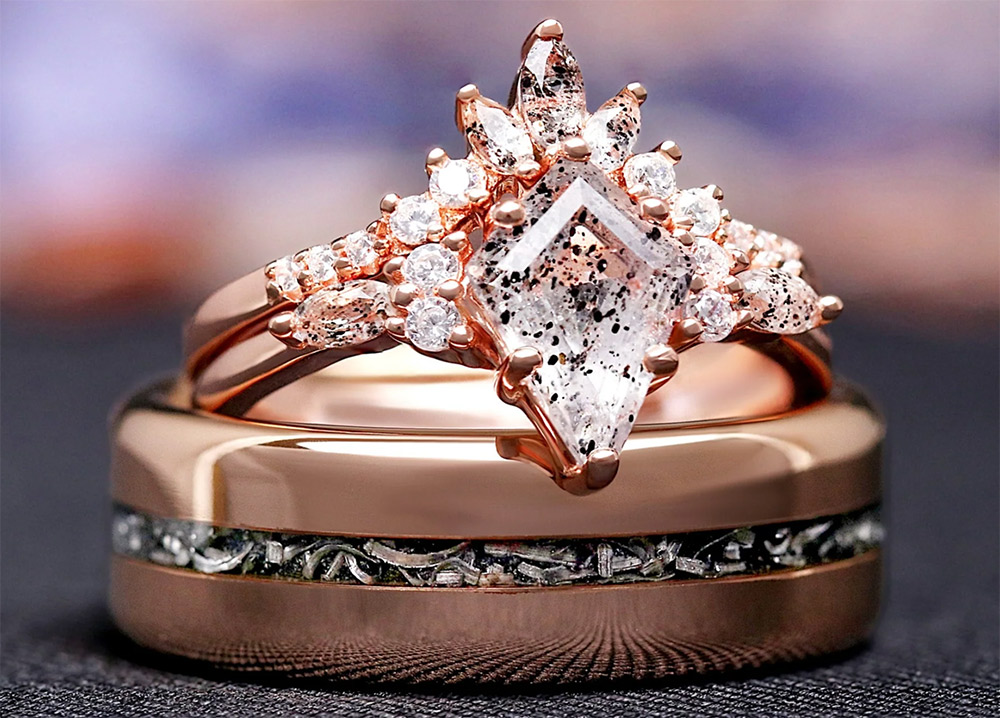
Designers have learned that meteorite pairs well with contrast. It can be set against brushed titanium, warm rose gold, or classic yellow gold to emphasize its cool, grey complexity. The material’s surface has a natural movement, so even a simple band can feel alive in changing light. This is a kind of elegance that rewards attention, not a kind that demands it. In photographs it looks refined, but in person it has depth.
In the jewelry world, “minimal” can sometimes mean generic. Meteorite prevents that slide into anonymity because its pattern is inherently varied. Two rings may be the same design on paper, yet the etched lines will not be identical. This supports a broader shift in taste toward personalization without excessive customization. The ring feels tailored even when it is built from a classic template, which is a designer’s ideal balance.
Symbols of Commitment, Reimagined
Meteorite rings have become a favored alternative for couples who want commitment symbols that feel contemporary. The material’s journey, from the cold of space to the warmth of a hand, mirrors the human desire to give permanence to emotion. When people choose meteorite for a wedding band, they are often choosing a metaphor that goes beyond romance. They are choosing endurance, distance traveled, and the improbable meeting of two paths. It is a subtle statement, but an intentional one.
This symbolism resonates across different kinds of relationships, not only traditional engagements. Couples looking for matching bands often want a shared element that still allows individuality. Meteorite provides that shared anchor because the origin is the same while the visible pattern remains unique. The rings become paired objects, not cloned objects. That distinction matters to buyers who see partnership as a union of two distinct lives rather than a single blended identity.
As more couples shop online for rings that feel personal rather than prescribed, a small group of relationship-focused e-commerce jewelers has started curating materials with built-in narrative power, including meteorite, alongside matching sets, engagement styles, and men’s wedding bands that avoid the usual cookie-cutter look. One example is foreveringsjewelry.com, a brand built around rings designed to represent meaningful relationships, where the emphasis is on symbolism and shared story as much as on the silhouette itself. If you are curious about space-forged materials, you can browse their meteorite ring designs in the same spirit, as an editorial alternative to conventional bands rather than a novelty.
Craft, Durability, and the Reality of Wear
A meteorite ring is not only a story; it is also a piece of equipment you wear every day. That brings practical concerns that are worth treating with the seriousness usually reserved for watches. Many meteorites contain iron, and iron can be vulnerable to corrosion if not properly stabilized, sealed, or paired with protective materials. A well-made meteorite ring is typically treated to reduce oxidation and preserve the etched pattern. The craftsmanship is not optional, because the romance of space does not prevent a ring from meeting soap, sweat, and humidity.
Good designers address these realities with intelligent construction. Meteorite may appear as an inlay rather than a full band, protected by stronger surrounding metals. Some rings use resins or advanced coatings, while others rely on careful finishing and maintenance guidance. Buyers should understand what they are purchasing, including how the meteorite is integrated and whether it can be refinished. In other words, the ring’s story should be matched by the maker’s competence.
Maintenance is straightforward, but it is not nonexistent. Owners often benefit from keeping the ring dry when possible, removing it for harsh chemicals, and storing it thoughtfully. Occasional professional cleaning helps preserve clarity in the etched surface. The upside is that a meteorite ring can age beautifully, developing a patina that feels earned rather than worn out. When cared for properly, it becomes one of those objects that looks better because it has been lived with.
The Emotional Geometry of Pattern
Meteorite patterns offer something rare in jewelry: a natural design that looks intentional. The lattice lines can resemble topographic maps, branching rivers, or architectural grids. People project meaning onto these shapes because the shapes are complex enough to invite interpretation. Unlike a machine-made texture, the meteorite surface reads as organic, which makes it feel personal. It is the same psychological phenomenon that makes people stare at wood grain or marble veining.
This emotional geometry plays into the appeal of rings as intimate artifacts. A ring is one of the few objects that remains constantly attached to the body, seen dozens of times a day. When that ring contains a pattern that seems to shift with light, it becomes a small visual ritual. The wearer notices it when nervous, when bored, when happy, when lost in thought. Over time, the pattern becomes familiar, like a private landscape. It is a comfort object disguised as jewelry.
There is also a modern sensibility in embracing imperfection and variation. For decades, luxury leaned toward flawless uniformity. Today, many buyers prefer character over polish, and meteorite offers character without sacrificing refinement. The lines are not defects; they are evidence. That is a subtle but powerful shift in taste, and it helps explain why meteorite rings feel current rather than eccentric. They align with a broader cultural desire for objects that tell the truth about what they are.
Style Pairings: From Formal to Everyday
Meteorite rings can be surprisingly versatile, partly because their color palette is restrained. The typical grey and silver tones behave like a neutral fabric in menswear, pairing easily with steel watches, black leather, and navy suits. In formal settings, meteorite reads as distinctive but not loud, especially when framed by classic metals. It can complement a tuxedo as comfortably as it complements a crisp oxford shirt. The ring’s interest lives in texture, not in color clashes.
In casual life, meteorite feels natural alongside denim, knitwear, and the utilitarian silhouettes that define modern wardrobes. Many people prefer jewelry that does not require a costume change, and meteorite meets that demand. A matte finish can look understated and rugged, while a polished edge can sharpen the look for the office. The material’s subtle complexity keeps it from feeling like an accessory chosen in haste. Even when the outfit is simple, the ring can add a sense of intention.
For those who like layering, meteorite also pairs well with mixed-metal styling. It can sit next to gold bracelets, silver chains, or signet rings without fighting for attention. The key is balance, letting meteorite serve as a textured anchor rather than competing with other statements. This is where celestial design becomes practical design. The ring provides visual depth that remains compatible with almost any personal style. That compatibility is a major reason meteorite rings are moving from niche fascination to mainstream consideration.
Why Celestial Materials Still Matter
Meteorite rings thrive because they answer a modern appetite for meaning that feels earned. In a world of fast trends, the idea of wearing something that traveled through space provides a counterweight. It suggests that some things are not designed for a season, but for a life. The ring becomes a reminder that permanence is possible, even if everything else feels in motion. That message is not sentimental; it is grounding.
There is also an ethical and philosophical dimension to choosing a nontraditional material. People are increasingly skeptical of luxury stories that sound rehearsed. Meteorite has a story that is difficult to fake, and it invites the buyer to learn rather than simply consume. When jewelry becomes educational, it gains a kind of dignity. The purchase can feel like participation in a narrative rather than acquisition of a status token.
Ultimately, the celestial design appeal is not only about space. It is about perspective, the way an object can expand the mind even as it sits quietly on a finger. Meteorite rings compress wonder into an everyday form. They allow romance, science, and craft to occupy the same small circle. That is why the trend endures, not as a gimmick, but as a durable taste for objects that carry more than decoration. In the end, the meaning is simple: you can wear a story, and you can keep it close.
Hits: 3924 | Leave a comment
Tags:meteorite rings, jewelry, rings
About the Author

Stella Cooter
Journalist, traveller and mother, Stella writes about fashion and style, luxury and adventure.