
How to Match an Engagement Ring With Your Personal Style
Round diamonds account for about half of all engagement ring purchases at the largest online retailers, with oval near 16% and princess near 7%. Those figures describe default behavior at the counter. Buyers pick the shape they have seen most often, then notice the finished ring has no relationship to the jewelry they already own. A ring that matches personal style gets chosen in reverse, starting from the pieces worn every day.
Signals in the Jewelry Already Owned
The most useful reference material is already in the house. Look at the items that go on without thought, such as the earrings worn every morning, the watch, the chain that never comes off.
Record three things about them. The metal color, the scale against the hand, and the surface finish.
Most people find one metal dominates the collection by a wide margin. That dominance is the strongest signal available before any shopping begins. A ring in a metal nobody in the collection wears will look borrowed, and it will pull attention away from every other piece on the same hand.
Finish deserves its own note. Someone who owns only high-polish pieces will find a matte or hammered band looks unfinished next to them. The opposite holds as well. Polished platinum next to a stack of brushed silver bangles produces a visible mismatch that no stone size corrects.
Metal Tone Against Skin and Wardrobe
Yellow gold now appears in 36% of rings, level with white gold and up from 9% in 2017. Platinum is third at 13%, and sterling silver follows at 10%. Plenty of buyers still default to a white metal without checking what they already own.
Platinum bands cost $1,000 to $2,500 and gold bands $1,000 to $1,200. Platinum keeps its white color permanently. White gold is yellow gold finished with rhodium plating, and that plating needs renewal on a schedule for the ring to keep the same color. Anyone who dislikes appointments should factor that in before choosing it.
The rest of the hand is what decides metal tone. A yellow gold ring on a wrist wearing a steel watch creates two competing tones at close range, and the eye picks up the conflict immediately. Buyers who own a single watch they never remove should treat that watch as the fixed point and choose around it.
Shape Selection by Visual Preference
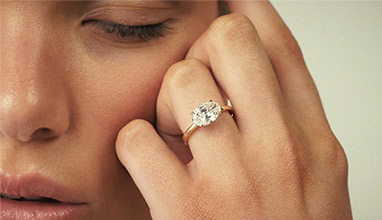
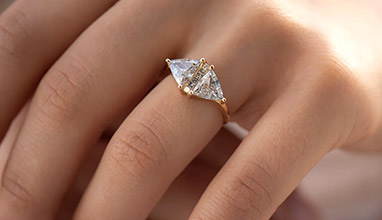
Set a princess beside an oval, and the difference is structural. Diamond shapes divide into two groups that behave differently on the hand. The geometric group has straight edges and defined corners, and it covers princess, emerald, asscher, and radiant. The curved group uses continuous outlines, which brings in round, oval, pear, and marquise.
Wardrobe usually predicts which group a person prefers. Tailored clothing, structured bags and hard-edged watches pair with geometry. A princess cut engagement ring is built on square corners and returns light in broad flashes, while an emerald cut gives long parallel planes and much less sparkle. Soft fabrics and rounded silhouettes point the other way, toward oval or round.
The fastest mover in the fancy category is marquise, with sales up 94% year over year against a share near 8%. Buyers choosing it generally want length on the finger without the width of an oval. That preference has a practical side, since an elongated stone covers more of the finger and gives the impression of a larger carat weight at the same price.
Accent Stones and Overall Density
Ring style also divides by how much metal and how many small stones surround the center. In a national study of 2024 buyers, 51% of rings had a center stone accented by side stones or other detail, against 32% holding a bare solitaire. The hidden halo, a band of small stones set beneath the center stone where only a side view reveals them, broke into the top two settings that year, behind the plain prong setting that 35% of buyers chose.
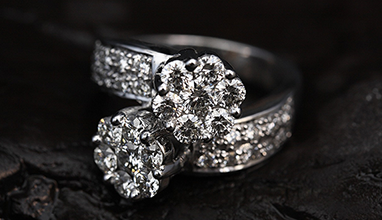
A pavé band looks busy within a month on a hand that wears few accessories. Layered necklaces and stacked rings produce the reverse problem, where a bare solitaire disappears against everything else on the body. Neither group is served by the other group's ring, and the mismatch is obvious in photographs long before the wearer can explain it.
There is a maintenance angle to density as well. Every small stone in a pavé band has its own tiny prongs, and those loosen on the same schedule as larger ones. A band holding 30 accent stones gives 30 opportunities for a loss, which is a reasonable argument for channel or bezel-set accents on a hand that takes abuse.
Setting Profiles for Daily Wear
A week of ordinary wear is enough to show what setting height does. The bezel setting wraps the girdle of the stone in a continuous metal rim and stays low against the finger. It resists snagging on fabric, and a well-made one can go 10 to 15 years before it needs attention. Jewelers point people who work with their hands toward it, including nurses and anyone in a trade.
Prong settings leave more of the stone exposed. Handwashing and gripping surfaces thin the metal, and the tips catch on sweaters and hair, which bends them outward. Prongs need periodic inspection and retipping. Someone who gardens or handles patients for a living will spend real money keeping a high-set prong ring intact.
Height also changes how the ring pairs with a wedding band. A tall cathedral setting leaves a gap under the stone that a straight band cannot close, which pushes the buyer toward a contoured band later.
Proportion and Hand Size
Center stones now average between 1.5 and 1.9 carats. Lab-grown centers average 2.0 carats and natural centers 1.6, a gap produced by price. Buyers have watched prices drop in both categories, with natural stones off 26% in two years and lab-grown stones off 74% from their 2020 level, so a fixed budget now buys more size than it did. Size interacts with the hand it goes on. A 2-carat round on a size 4 finger covers knuckle to knuckle and photographs as a statement piece. The same stone on a size 8 finger looks proportionate. Band width follows the same logic, since a 1.5 millimeter band disappears on a broad hand and a 3 millimeter band overwhelms a narrow one.
The Short List for a Style Match
Matching a ring to personal style is a narrow task with three inputs. The metal already dominant in the collection, the shape group the wardrobe points to, and a setting height the hands can tolerate. Past those three, the remaining decisions are preference with no structure behind them, which is why so many buyers stall for months and then default to the shape they saw on someone else.
A buyer who answers the three questions before looking at inventory ends up reviewing a much smaller set of rings. The one selected will look related to the jewelry already owned, and it will still look that way in a decade.
Hits: 52 | Leave a comment
Tags:diamond, engagement ring, jewelry
About the Author

Stella Cooter
Journalist, traveller and mother, Stella writes about fashion and style, luxury and adventure.
Related Articles