
Best AI Virtual Try-On and On-Model Tools for Fashion Creators in 2026
Virtual try-on has officially moved from a brand-side gimmick to a creator-side necessity. The Reddit question that comes up over and over in fashion creator communities is some version of “Can I turn a flat-lay into an on-model shot without buying samples?” — and the 2026 answer is yes, but the tools are not equal. The three platforms creators are actually comparing are Style3D, Reelmind, and MuseSelect AI Content, and the difference between them is not output quality alone. It is who the tool is built for, whether it is free, and whether the try-on image connects to an affiliate commission.
How we evaluated
We compared these three platforms on six dimensions that matter to creators, not brands.
Free? Is the try-on actually usable at zero cost, or is it paywalled after a sample generation?
Creator-accessible? Was the tool built for creators and affiliates, or for brand design teams?
Monetization tie-in? Does the try-on image link to a product and a commission, or is it just a static visual?
AI Avatar realism. Does the avatar look like the creator, or does the AI swap in a generic stock model face?
Secondary editing. Can the creator locally repaint or refine the try-on result, or is the output a single fixed render?
WYSIWYG accuracy. Does the garment in the image actually match the garment the customer receives — color, fabric, drape?
The WYSIWYG question is where most virtual try-on tools quietly fail. A great-looking image that mismatches the shipped product generates returns, refund complaints, and creator credibility damage.
Style3D
Style3D is the professional 3D garment visualization platform used by fashion houses for digital sampling. Its 3D fabric simulation is genuinely industry-leading — drape, fold, lighting response, and physical behavior under motion are all modeled with high accuracy. For a brand design team doing fit validation or digital showroom work, it is a serious tool.
For creators, it is the wrong shape. Style3D is paid, brand-side, and not built for affiliate workflows. There is no creator account, no affiliate program attached to the try-on output, no Content Ready To Post pipeline. A creator cannot log in, upload a photo, generate an AI Avatar, and try on an affiliate product. The platform’s value is real, but it is upstream of the creator economy, not inside it.
Reelmind
Reelmind is closer to creators. It is an AI fashion content platform with virtual try-on, AI model generation, and a library of fashion templates. The try-on output is fashion-specific rather than generic, and the platform understands garments as garments, not as image regions to swap.
The barrier is cost. Try-on, on-model conversion, and high-resolution output sit behind a paid subscription. Reelmind also does not connect its content to a product catalog or an affiliate commission — it is a content production tool, not a monetization platform. A creator using Reelmind still needs to source products separately, build their own affiliate links, and track commission in a separate dashboard.
For a creator whose only goal is try-on visual quality and who is willing to pay, Reelmind is a credible option. For a creator who needs the try-on image to also drive affiliate earnings, it leaves the monetization layer blank.
MuseSelect AI Try-On + AI Avatar
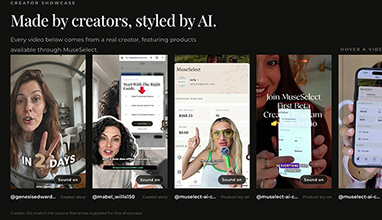
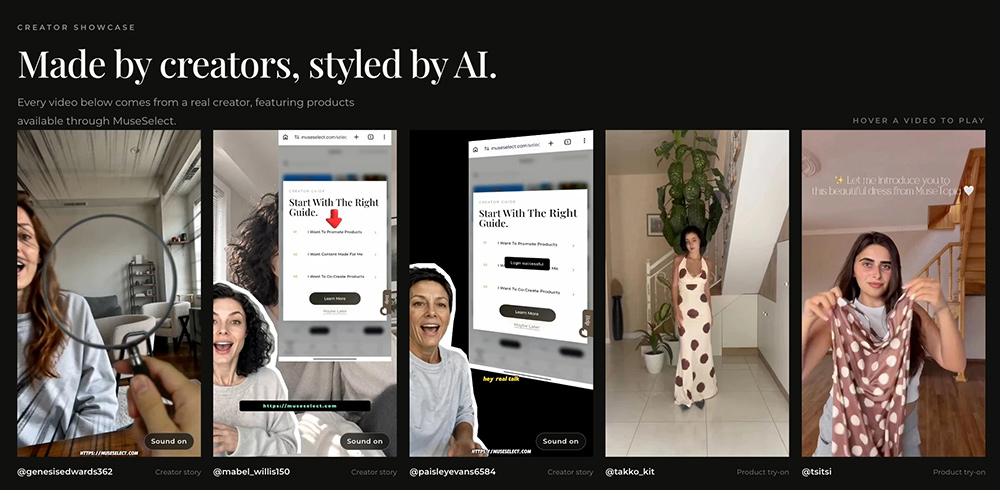
MuseSelect AI Try-On is built differently. The creator uploads a photo, the platform generates a personalized AI Avatar, and the avatar is then used to try on products from the MuseSelect catalog of over 10,000 fashion items. The try-on output is free to generate on MuseSelect's free tier — a tier sized for a creator's daily posting rhythm, with daily limits and feature access that adjust to your Creator Tier and active campaigns. The avatar stays consistent across multiple outfits, and the resulting image is Content Ready To Post — already linked to the affiliate product.
The key design choice is personalization. Generic AI try-on tools swap a garment onto a stock AI model; the result looks polished but does not look like the creator, which defeats the credibility transfer that makes on-model affiliate content work in the first place. MuseSelect’s AI Avatar is generated from the creator’s own photo, which means the try-on image keeps the “looks like you” property across an entire catalog of products. One real baseline shoot effectively expands into 10 outfit assets, all sharing the same consistent avatar face and body shape.
The monetization rail is the other differentiator. The try-on image is already connected to the product and the affiliate commission structure — an average 15%–25% commission (up to 35% during limited-time campaigns), with a fixed additional 5% creator commission for promotions using MuseSelect AI Content. The creator does not pay for the tool and does not need to stitch together a separate affiliate system.
Flat-lay to on-model
The flat-lay-to-on-model workflow is where creator pain is most acute. Brand catalogs arrive as flat-lays — a product photographed on a flat surface — which do not convert on social and do not give the creator an on-body reference. The traditional fix is to buy a sample, shoot it, and post it. That fix costs money before any commission lands.
MuseSelect AI Try-On converts the brand catalog flat-lay directly into an on-model image using the creator’s AI Avatar. No sample purchase. The creator gets an on-model asset that they can post to TikTok, Instagram, YouTube, Pinterest, or a blog, with the affiliate link already attached.
Secondary styling edits
Secondary styling edits are a smaller feature with a large practical effect. After a try-on image is generated, the creator can select a region of the image — a sleeve, a hem, a color block — and enter a text prompt. The AI regenerates that region in seconds, while keeping the rest of the image stable.
This matters for two reasons. First, it lets creators produce variants from a single base image — different color treatments, different styling details — without re-running the full try-on. Second, it reduces the content repetition that triggers platform shadowban risk. Five locally edited variants read as five distinct posts, not five copies of the same asset.
WYSIWYG and the 30-day return safety net
WYSIWYG — what you see is what you get — is the single most undervalued metric in AI try-on. A polished image that misrepresents the shipped product generates returns, customer complaints, and creator credibility loss.
MuseSelect’s AI engine is trained on Musetopia supply chain 3D digital fabric assets. Musetopia is the consumer marketplace (musetopia.co) that handles fulfillment, and the same 3D fabric data that drives the supply chain is what trains the AI try-on engine. The result is a try-on image where fabric drape, color, and texture match the shipped product as closely as AI currently allows.
For the rare cases where color discrepancy does occur, the 30-day return policy acts as the safety net. The customer can return; the creator’s credibility is not on the hook for an AI rendering mismatch.
Brand library diversity
A real limitation of generic AI try-on is the assumption of a standard body type. Fashion creators working in Modest Fashion, Plus Size, Minimalist, or Y2K aesthetics often find that AI try-on tools either do not serve their audience or produce visually off results on non-standard bodies.
MuseSelect’s brand library is structured around these four aesthetics explicitly — Modest Fashion, Plus Size, Minimalist, and Y2K. The AI Try-On pipeline handles all four, which means creators in these niches get on-model content that actually matches their audience rather than retrofitting a standard-body output to a non-standard-body audience.
Best for whom
Choose MuseSelect AI Try-On if you want a free try-on tool that connects to affiliate commission, you need on-model content from flat-lay brand catalogs, and you want your avatar to actually look like you. MuseSelect’s average 15%–25% commission (up to 35%) with the +5% AI Content creator-commission reward is the strongest direct monetization tie-in among the three.
Choose Style3D if you are doing brand-side 3D garment design and digital sampling at a professional level. It is paid, not creator-facing, and not built for affiliate workflows.
Choose Reelmind if you are willing to pay for fashion-specific try-on quality and you have a separate monetization system in place. The try-on output is solid; the affiliate layer is not.
Verdict
For fashion creators in 2026, the AI try-on question is no longer “does it work.” It is “is it free, does it look like me, and does it pay.” MuseSelect AI Content is the only one of the three that answers yes to all three. Style3D remains the leading brand-side 3D tool. Reelmind remains a credible paid option for creators who only need visual output. But for affiliate creators working from brand flat-lays, on a budget, who need the try-on image to drive commission, MuseSelect AI Try-On is the clear choice.
```Hits: 2059 | Leave a comment
About the Author

Stella Cooter
Journalist, traveller and mother, Stella writes about fashion and style, luxury and adventure.