
From the Runway to Recess: How High-End Children's Wear Is Sweeping Campus Fashion
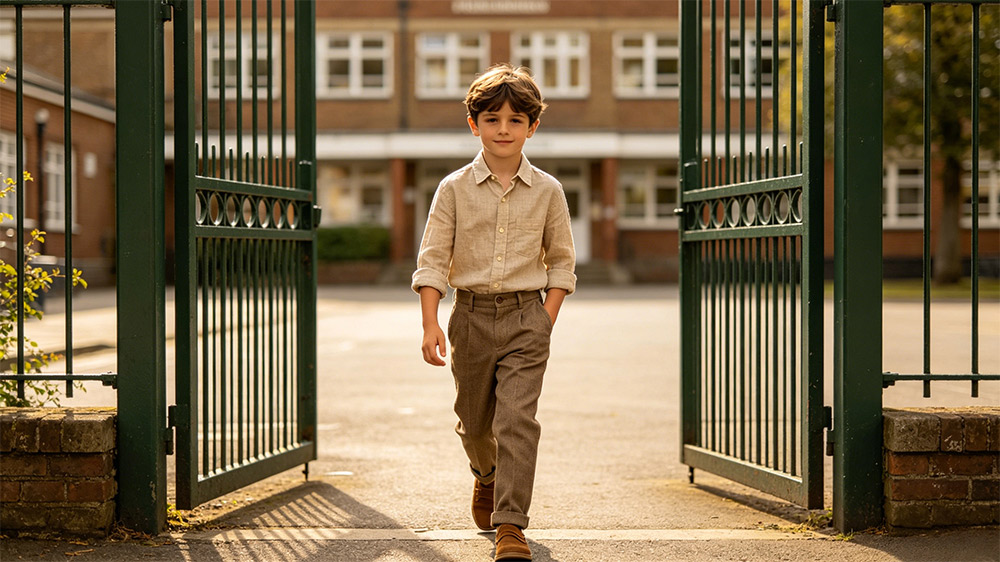
I was standing outside my daughter's school - a perfectly ordinary Tuesday, travel mug in hand - when I noticed a boy no older than eight walking through the gate in a perfectly cut linen shirt, slim trousers in warm camel, and a pair of New Balance 574s in pristine white. He looked like he'd just stepped out of a Kinfolk editorial. His mother, in a rush and barely glancing back, clearly hadn't given it a second thought.
That's when I understood something had quietly shifted. High-end children's wear isn't a niche obsession anymore. It's the new normal at the school gate - and if you haven't noticed it yet, look again.
The School Gate Has Become Fashion's Most Honest Front Row
Working in children's fashion for the better part of a decade, I've watched trends filter down from adult runways into kids' collections, season after season. But what's happening right now feels different in kind, not just degree. The language parents use when shopping for their children has genuinely changed. Terms that once lived exclusively in fashion editorial - capsule wardrobe, tonal dressing, investment layering - now come up in conversations between parents at pickup. A friend of mine spent twenty minutes recently debating whether a particular shade of forest green read "too adult" for her six-year-old's back-to-school coat. The coat, for the record, was from a small independent label she'd found on Instagram. It was beautiful.
This shift is generational and it isn't reversible. Millennial parents - the generation that watched streetwear become art, that built personal style identities during fashion's most culturally rich decade, and that subsequently grew disillusioned with fast fashion's environmental cost - are now the primary buyers in the children's clothing market. They bring their full aesthetic vocabulary with them when they shop for their kids. The market, to its credit, has responded. Hapa Garments is part of that response: a brand built on the conviction that children's clothing deserves the same care, intentionality, and material integrity that the most thoughtful adult fashion has always demanded.
What "High-End" Actually Means on a School Campus Today
Here's something worth clarifying upfront: when I talk about high-end children's wear, I'm not necessarily talking about price. I'm talking about sensibility. The look dominating school campuses in 2026 is restrained where children's fashion once celebrated noise. The palette is warm and grounded - oatmeal, terracotta, dusty rose, deep forest green, and those nuanced off-whites that glow rather than glare. These are not colours chosen for durability or convenience. They're colours that have been thought about. Silhouette matters now in a way it simply didn't a decade ago. Walk past a school gate and you'll see structured outerwear that holds its shape across a whole term, trousers with a real break and a clean line, shirts whose collars lie flat without being ironed. The influence of adult minimalism - the A.P.C. and Margaret Howell school of dressing - has quietly filtered down into how parents dress seven-year-olds for a school Tuesday. And fabric has become the real conversation. I've spent years talking to parents about what they actually want from children's clothing, and the answer has shifted from "durable and washable" to something more like: will this still look good after thirty washes, and what is it actually made of? The properties of organic cotton versus conventional, the way linen softens and improves over time, the thermal intelligence of merino wool - these are things style-conscious parents now genuinely understand and ask about.
The Brands That Are Setting the Standard
The children's fashion landscape today spans a wider and more interesting range than at any previous point, and navigating it well requires knowing roughly where each brand is positioned and what it stands for beyond a price tag. At the prestige end, Bonpoint remains the benchmark - the Parisian house that has defined refined high-end children's wear for decades, whose collections read as editorial and whose materials age like heirlooms. Caramel Baby & Child, out of London, operates in the same register: considered, unhurried, and made for parents who want clothing to outlast a single season.
The mid-market is where I spend a lot of my own attention, because it's where design quality has advanced most dramatically. Rylee + Cru has built a devoted following through nature-inspired prints and an earthy palette that slots naturally into a school wardrobe. Quincy Mae brings the same quiet sensibility to younger children. Minnow has expanded from resort wear into everyday dressing with the kind of architectural confidence that used to be the exclusive property of the top end.
And then there's the accessible tier - Arket Kids, Zara Kids, Uniqlo's children's line - where the democratisation of quality design is most visible. The gap between what's achievable at the prestige level and what's available to most families has narrowed considerably. That narrowing is, I think, one of the most significant stories in children's fashion right now. If you've ever wondered whether this kind of brand landscape is something you could participate in yourself, the guide on how to start your own children's clothing brand is a genuinely useful starting point - it maps the market more clearly than almost anything else I've read.
Your Child Has More to Say About This Than You Might Think
One of the things I've noticed - and it took me longer than it should have to notice it - is that children are not passive in their own fashion choices. Not even close. My daughter has been expressing clear clothing preferences since she was four. Not in a difficult or demanding way; she just noticed things. She knew which colours she felt like herself in. She had opinions about how things moved when she walked. She pushed back, gently but consistently, against anything that felt itchy, stiff, or - her precise word - "loud." She is seven now and her eye for a good outfit is, genuinely, better than many adults I know.
A generation raised on visually rich digital content - family style accounts, aesthetic-driven YouTube channels, the constant beautifully designed environment of the apps they've grown up with - has developed a real visual literacy. Children today talk about clothing with a specificity that earlier generations simply didn't have at this age. They're not fashion victims. They're not little adults. But they are active participants in how they present themselves to the world, and the parents who take that seriously find the whole business of getting dressed considerably less fraught.
The most effective approach I've found - both personally and in the conversations I have with other parents — is collaborative. A child who has had some genuine input into their school wardrobe wears those clothes differently. The coat in the specific shade of green they campaigned for, the shoes they chose themselves, the shirt they picked because it "felt right" - these aren't just purchases. They're the early vocabulary of a self.
Building a School Wardrobe That Actually Works
Let me be practical for a moment, because the aesthetics are only half the challenge. Children are hard on clothes. Lunch happens. Knees meet asphalt. Growth spurts are merciless and poorly timed. The parents I know who dress their children most effectively - who manage to maintain genuine style without turning the whole enterprise into a financial or logistical ordeal - tend to work the same way. Here's what I've seen work consistently:
Start with a coherent palette. Three or four colours that work together across a whole wardrobe mean that almost any combination of pieces produces an outfit. It removes the paradox of a full wardrobe with nothing to wear — a phenomenon that strikes children's clothing collections just as reliably as adult ones.
Invest in outerwear before anything else. A coat is the most visible piece in a school wardrobe and the one that gets the most use. A well-made coat in a clean, versatile silhouette will outlast everything else in the wardrobe, cover whatever's underneath, and — if you buy one size up - span two full school years without looking oversized.
Take footwear seriously. The current children's footwear market is genuinely impressive: heritage sneaker brands making children's versions of their most iconic silhouettes, quality leather makers producing school-ready styles that hold their shape across a full term. A well-chosen pair of shoes can anchor an entire palette and elevate even the simplest outfit.
Buy less, on purpose. The capsule approach isn't a compromise - it's a strategy. Fewer pieces, chosen carefully and maintained well, will produce better results aesthetically, financially, and practically than a wardrobe full of volume purchases that don't connect. According to The Good Trade's guide to sustainable children's fashion, this approach also significantly reduces a family's textile waste footprint - which, if you're choosing quality materials, matters even more.
Why This Shift Isn't Going Anywhere
I want to be clear about something: what we're seeing in children's school fashion isn't a trend in the usual sense. Trends arrive, peak, and recede. This is something different - a structural change in how a generation of parents thinks about value, sustainability, and what it means to dress their children well.
The move toward high-end children's wear and quality-first school dressing is rooted in things that don't reverse: an understanding that cheap, rapidly-replaced clothing is expensive in the long run; a belief that children's clothing should be made with the same material integrity as adult fashion; and a growing awareness that the environmental cost of disposable kids' clothes is real and worth taking seriously.
At Hapa Garments, this is the conversation we've been having since we started. We make children's clothing for school and everyday wear from GOTS-certified organic materials - fabrics that are as kind to a child's skin as they are to the environment - in silhouettes designed to last through the kind of daily use that school-age life actually involves. The linen sets that survive a full term of school lunches. The outerwear that looks as good in March as it did in October. The basics in a palette considered carefully enough that they form the quiet foundation of an entire wardrobe. We design these pieces because we believe that dressing children well — not expensively, but well, with intention and genuine attention to craft - is worth doing properly. The runway has always set the standard. The recess yard has always been where that standard gets tested against real life. We make clothes that are built to pass both tests.
Hits: 1372 | Leave a comment
About the Author

Stella Cooter
Journalist, traveller and mother, Stella writes about fashion and style, luxury and adventure.
Related Articles